English Education in India, 1715-1835 by Rajesh Kochhar
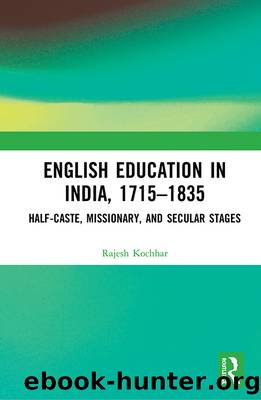
Author:Rajesh Kochhar [Kochhar, Rajesh]
Language: eng
Format: epub
Tags: History, Asia, India & South Asia, General, Social Science
ISBN: 9781000169355
Google: qp_5DwAAQBAJ
Publisher: Taylor & Francis
Published: 2020-09-15T01:39:12+00:00
Eastâs Letter to the Fourth Earl of Buckinghamshire
On 17 May 1816 East wrote a letter to the fourth Earl of Buckinghamshire who, as the President (1812â16) of the Board of Control for India, was the official in charge of Indian affairs and, as such, Eastâs appointing authority. In the seven-page letter addressed to âMy Lordâ, East gives an account of the 14 May meeting, along with some background information and general comments. The contents are similar to those of Eastâs 16 May letter. In those days letters were carried by ships. Until the sailing day the letter would remain with the writer who could add further material. There is a postscript simply dated May 1816 âthat sets out the resolutions adopted at a general meeting at Sir E. Hyde Eastâs relating to the establishment of âThe Hindoo College of Calcuttaââ.95 As the postscript reports on the proceedings of the meeting held on 21 May, it must have been added on that date or shortly afterwards. In the meantime, however, the Earl had died on 4 February, even though the news reached Calcutta on 6 June 1816. We do not know when the letter was posted or who received it in England. A copy of it survives in the Lambeth Palace Library.96 In the Indian context, the letter was discovered by A. F. Salahauddin Ahmed in 1975, who published it.97 However, what he discovered was incomplete, leading to misrepresentation, as will be seen. The latter part of the letter carries the postscript, of which he did not become aware. The postscript is being mentioned here for the first time on the basis of the information received from the holding library. It is, however, comforting to know that the letterâs contents are consistent with those of the letter written a day earlier.
The Committee met on 27 May 1816, again at Eastâs residence. It proceeded as if it were there to stay. The Committee approved âpreliminary rulesâ, which were âto form part of the detailed plan, which the Committee had been requested to prepare and lay before a future General Meetingâ. On the proposition of East, one of the European members, Lieutenant Francis Irvine, was appointed English Secretary to the Committee on a monthly salary of Rs 300, while predictably Buddinath Mookerjya, as a non-member, was selected to assist him as Native Secretary98 at Rs 100. (The posts were subsequently made honorary on Hareâs insistence to avoid wasteful expenditure.99) Collecting subscriptions was to be strictly a preserve of the Indian members of the Committee, who were asked to report at the next meeting âthe best means of raising a sufficient sumâ. A four-member Select Committee comprising an English chairman Blacquiere, and three Indians â Ram Gopal Mullick, Gopee Mohun Deb, and Huree Mohun Tagore â was formed âto take measures for providing a proper place for the site of the intended College, as well as to procure a temporary building for the purpose of commencing instruction in the Bengalee and English languages as soon as possibleâ.
Download
This site does not store any files on its server. We only index and link to content provided by other sites. Please contact the content providers to delete copyright contents if any and email us, we'll remove relevant links or contents immediately.
The Vikings: Conquering England, France, and Ireland by Wernick Robert(84247)
Ali Pasha, Lion of Ioannina by Eugenia Russell & Eugenia Russell(40261)
The Conquerors (The Winning of America Series Book 3) by Eckert Allan W(37475)
The Vikings: Discoverers of a New World by Wernick Robert(36981)
Cecilia; Or, Memoirs of an Heiress — Volume 1 by Fanny Burney(32562)
Cecilia; Or, Memoirs of an Heiress — Volume 2 by Fanny Burney(31959)
Cecilia; Or, Memoirs of an Heiress — Volume 3 by Fanny Burney(31945)
Empire of the Sikhs by Patwant Singh(23090)
The Secret History by Donna Tartt(19103)
Hans Sturm: A Soldier's Odyssey on the Eastern Front by Gordon Williamson(18596)
Cat's cradle by Kurt Vonnegut(15365)
Pimp by Iceberg Slim(14522)
Sapiens: A Brief History of Humankind by Yuval Noah Harari(14393)
Norse Mythology by Gaiman Neil(13376)
Talking to Strangers by Malcolm Gladwell(13376)
Leonardo da Vinci by Walter Isaacson(13341)
4 3 2 1: A Novel by Paul Auster(12403)
Underground: A Human History of the Worlds Beneath Our Feet by Will Hunt(12101)
The Radium Girls by Kate Moore(12035)
